Decoding Tyre Size
Choosing the right tyre starts with understanding the numbers and letters printed on your tyre's sidewall. While tyre markings may seem complicated at first glance, they provide essential information about the tyre's size, performance, load capacity, and speed capability. Knowing how to read these markings helps you select the correct replacement tyre, maintain vehicle safety, and ensure optimal driving performance.
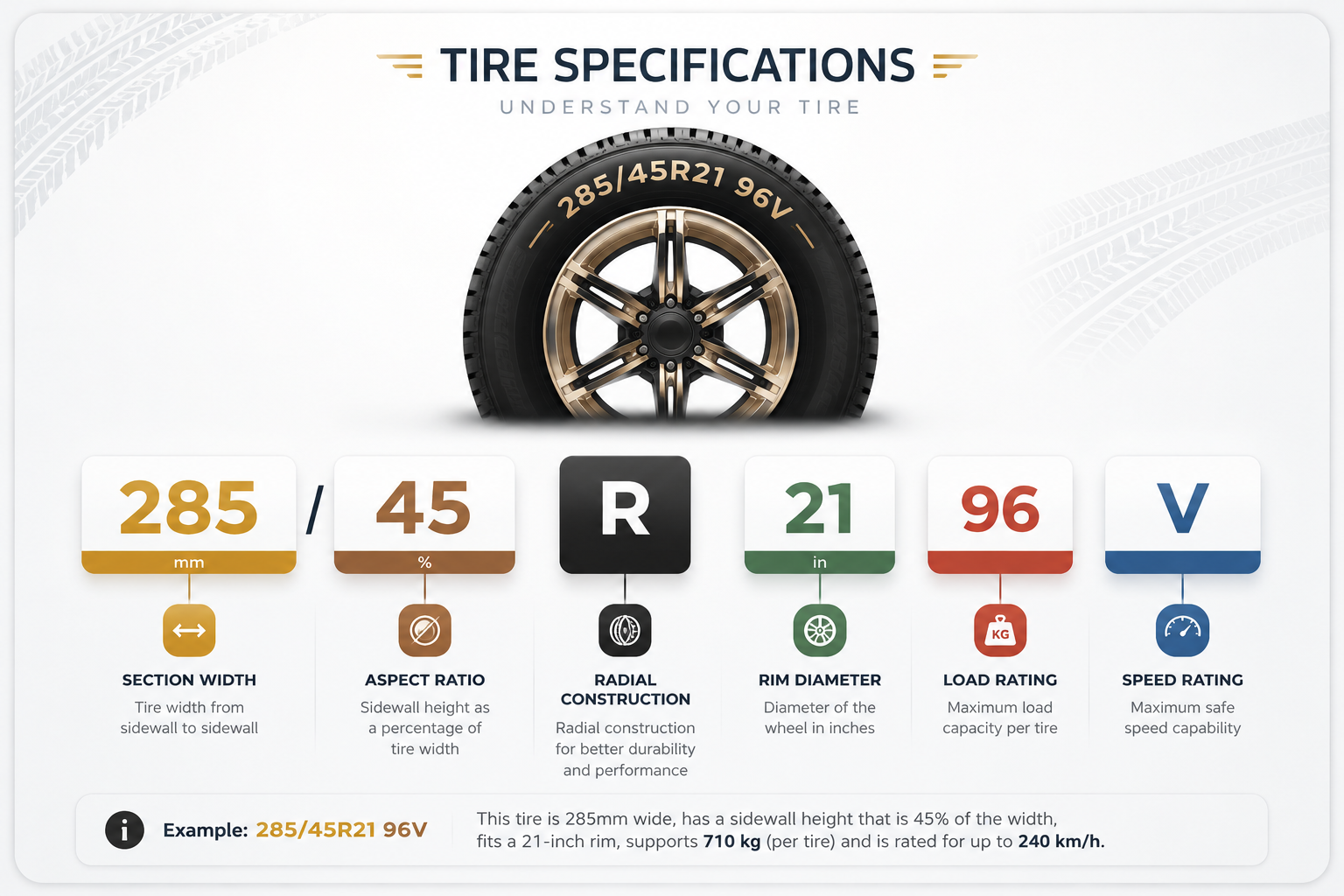
Tyre Width
The first number indicates the width of the tyre in millimetres, measured from sidewall to sidewall. Wider tyres generally provide increased road contact and improved handling.
Aspect Ratio (Profile)
The second number represents the tyre's aspect ratio or profile. It indicates the height of the tyre's sidewall as a percentage of its width. Lower-profile tyres typically offer sharper handling, while higher-profile tyres provide a more comfortable ride.
Radial Construction
The letter "R" stands for Radial, which refers to the tyre's internal construction. Radial tyres are the industry standard for modern passenger vehicles because they provide durability, stability, and fuel efficiency.
Rim Diameter
This number indicates the diameter of the wheel rim, measured in inches. The tyre must match the exact rim size specified by your vehicle manufacturer.
Load Index
The load index is a numerical code that indicates the maximum weight a tyre can safely carry when properly inflated. Choosing a tyre with the correct load index is essential for vehicle safety and performance.
Speed Rating
The speed rating is represented by a letter and indicates the maximum speed the tyre is designed to handle safely under recommended conditions. Always select a tyre that meets or exceeds your vehicle manufacturer's recommended speed rating.
Tyre Load Index Chart
The load index indicates the maximum weight a tyre can safely carry when properly inflated. Use the chart below to find the load capacity corresponding to your tyre's load index.
| Load Index | Pounds | Kilograms |
|---|---|---|
| 70 | 739 | 335 |
| 71 | 761 | 345 |
| 72 | 783 | 355 |
| 73 | 805 | 365 |
| 74 | 827 | 375 |
| 75 | 853 | 387 |
| 76 | 882 | 400 |
| 77 | 908 | 412 |
| 78 | 937 | 425 |
| 79 | 963 | 437 |
| 80 | 992 | 450 |
| 81 | 1019 | 462 |
| 82 | 1047 | 475 |
| 83 | 1074 | 487 |
| 84 | 1102 | 500 |
| 85 | 1135 | 515 |
| 86 | 1168 | 530 |
| 87 | 1201 | 545 |
| 88 | 1235 | 560 |
| Load Index | Pounds | Kilograms |
|---|---|---|
| 89 | 1279 | 580 |
| 90 | 1323 | 600 |
| 91 | 1356 | 615 |
| 92 | 1389 | 630 |
| 93 | 1433 | 650 |
| 94 | 1477 | 670 |
| 95 | 1521 | 690 |
| 96 | 1565 | 710 |
| 97 | 1609 | 730 |
| 98 | 1653 | 750 |
| 99 | 1709 | 775 |
| 100 | 1764 | 800 |
| 101 | 1819 | 825 |
| 102 | 1874 | 850 |
| 103 | 1929 | 875 |
| 104 | 1984 | 900 |
| 105 | 2039 | 925 |
| 106 | 2094 | 950 |
| 107 | 2149 | 975 |
| Load Index | Pounds | Kilograms |
|---|---|---|
| 108 | 2205 | 1000 |
| 109 | 2271 | 1030 |
| 110 | 2337 | 1060 |
| 111 | 2403 | 1090 |
| 112 | 2469 | 1120 |
| 113 | 2535 | 1150 |
| 114 | 2601 | 1180 |
| 115 | 2679 | 1215 |
| 116 | 2756 | 1250 |
| 117 | 2833 | 1285 |
| 118 | 2910 | 1320 |
| 119 | 2998 | 1360 |
| 120 | 3086 | 1400 |
| 121 | 3197 | 1450 |
| 122 | 3307 | 1500 |
| 123 | 3417 | 1550 |
| 124 | 3527 | 1600 |
| 125 | 3638 | 1650 |
| 126 | 3748 | 1700 |
Tyre Speed Index Table
Understanding your tyre's speed rating is essential for maintaining safety, performance, and manufacturer compliance. This table shows the maximum speed limits associated with each tyre speed index.
| Speed Code | Speed (mph) | Speed (km/h) | Category |
|---|---|---|---|
| L | 75 mph | 120 km/h | Off-Road & Light Truck Tires |
| M | 81 mph | 130 km/h | Temporary Spare Tires |
| N | 87 mph | 140 km/h | — |
| P | 93 mph | 150 km/h | — |
| Q | 99 mph | 160 km/h | Studless & Studdable Winter Tires |
| R | 106 mph | 170 km/h | H.D. Light Truck Tires |
| S | 112 mph | 180 km/h | Family Sedans & Vans |
| T | 118 mph | 190 km/h | Family Sedans & Vans |
| U | 124 mph | 200 km/h | — |
| H | 130 mph | 210 km/h | Sport Sedans & Coupes |
| V | 149 mph | 240 km/h | Sport Sedans, Coupes & Sports Cars |
| W | 168 mph | 270 km/h | Exotic Sports Cars |
| Y | 186 mph | 300 km/h | Exotic Sports Cars |
| ZR | 149 mph | 240 km/h | Exotic Sports Cars |
FAQs
How do I read a tyre size like 285/45R21 96V?
285 is the tyre width in millimetres, 45 is the aspect ratio (sidewall height as a percentage of width), R means radial construction, 21 is the rim diameter in inches, 96 is the load index, and V is the speed rating.
What does the load index number mean on a tyre?
The load index is a numerical code showing the maximum weight a tyre can safely carry when properly inflated. Choosing a tyre with the correct load index is essential for vehicle safety and performance.
What does the speed rating letter on a tyre mean?
The speed rating is a letter showing the maximum speed a tyre is designed to handle safely under recommended conditions. Always choose a tyre that meets or exceeds your vehicle manufacturer's recommended speed rating.
Do I need to match the exact tyre size printed on my vehicle?
Yes. The rim diameter must match your wheel exactly, and the width, aspect ratio, load index, and speed rating should meet or exceed what your vehicle manufacturer specifies — fitting the wrong size can affect handling, safety, and speedometer accuracy.
Not Sure Which Size Fits Your Car?
Our team at Lahore Tire can confirm the correct tyre size and specifications for your vehicle and help you find the right set in stock.
Call Lahore Tire Now